
Providing Access to APR Data, Science, and Research
About APR Therapy
APR therapy involves giving the mother progesterone after taking mifepristone. APR increases progesterone concentration levels to better compete with mifepristone and restore a normal pregnancy.
The evidence
Medical Evidence Summary
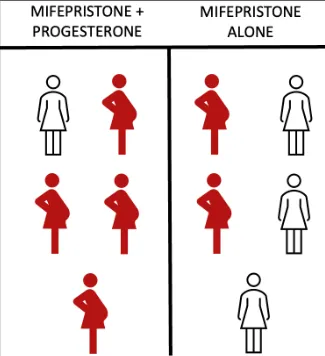
Since 2012, four case series (Delgado 2012; Garratt 2017; Delgado 2018; Delgado 2026), a randomized controlled trial (Creinin 2020), and a single-arm clinical trial (Turner 2024) have studied APR therapy in humans. The latest research shows that 55% of women who change their minds and receive progesterone after starting medication abortion with mifepristone can safely continue their pregnancies.
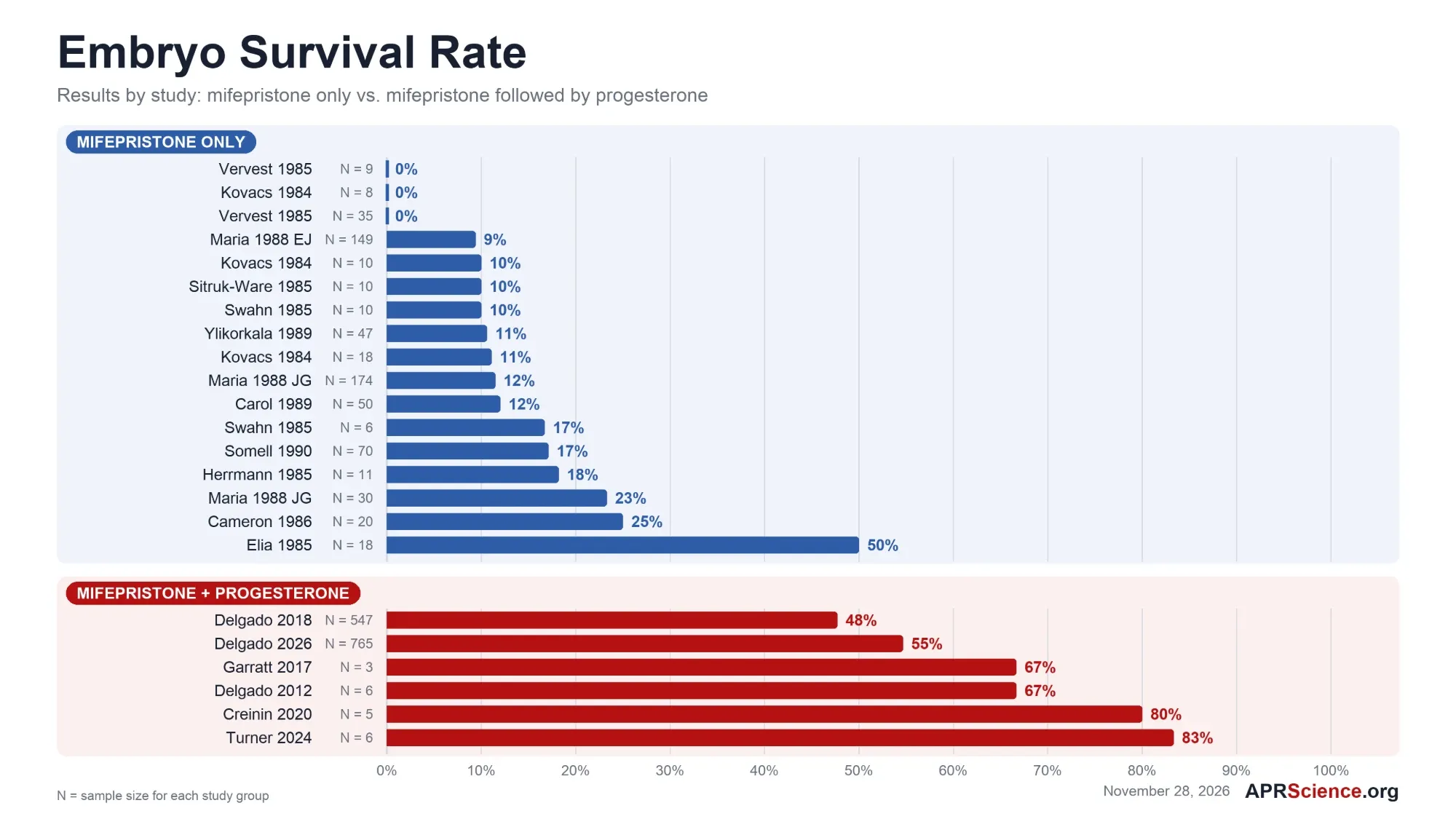
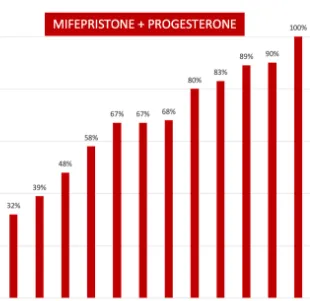
The chart above presents results from 17 mifepristone-alone studies (in blue) and from 6 mifepristone+progesterone studies (in red). Each of the studies used ultrasound to confirm embryo survival. The horizontal axis shows the embryo survival rate, also known as the continuing pregnancy rate (CPR), reported by each study. The results show that the embryo survival rate for mifepristone followed by progesterone is substantially higher than for mifepristone alone.
Questions & answers
Read the questions and answers below to learn about APR science.
- What is medication abortion and its drug regimen?The most common medication abortion regimen uses two drugs, mifepristone, and misoprostol. Mifepristone is a progesterone antagonist. Misoprostol triggers uterine contractions, expelling the embryo.Learn More →
- Can a medication abortion be reversed?Clinicians can stop the effects of mifepristone by increasing progesterone concentration. The progesterone outcompetes mifepristone for the binding sites on the progesterone receptors.Learn More →
- Is APR therapy safe for women?The American Society for Reproductive Medicine reports no increased risk from using progesterone in early pregnancy. Physicians have safely used progesterone in reproductive medicine since the late 1970's.Learn More →
- What are the three outcomes after mifepristone ingestion?Complete abortion (embryo demise, uterine evacuation), incomplete abortion (embryo demise, no/incomplete uterine evacuation), or continuing pregnancy (embryo survival).Learn More →
- What is the continuing pregnancy rate after mifepristone alone?Evidence from five studies since 2015 shows that the continuing pregnancy rate after ingesting mifepristone alone is generally below ≤25 percent for gestational age ≦49 days.Learn More →
- What is the continuing pregnancy rate after APR treatment?Evidence shows the continuing pregnancy rate after APR treatment is 65 percent or higher, well above the ≤25 percent continuing pregnancy rate for mifepristone alone.Learn More →